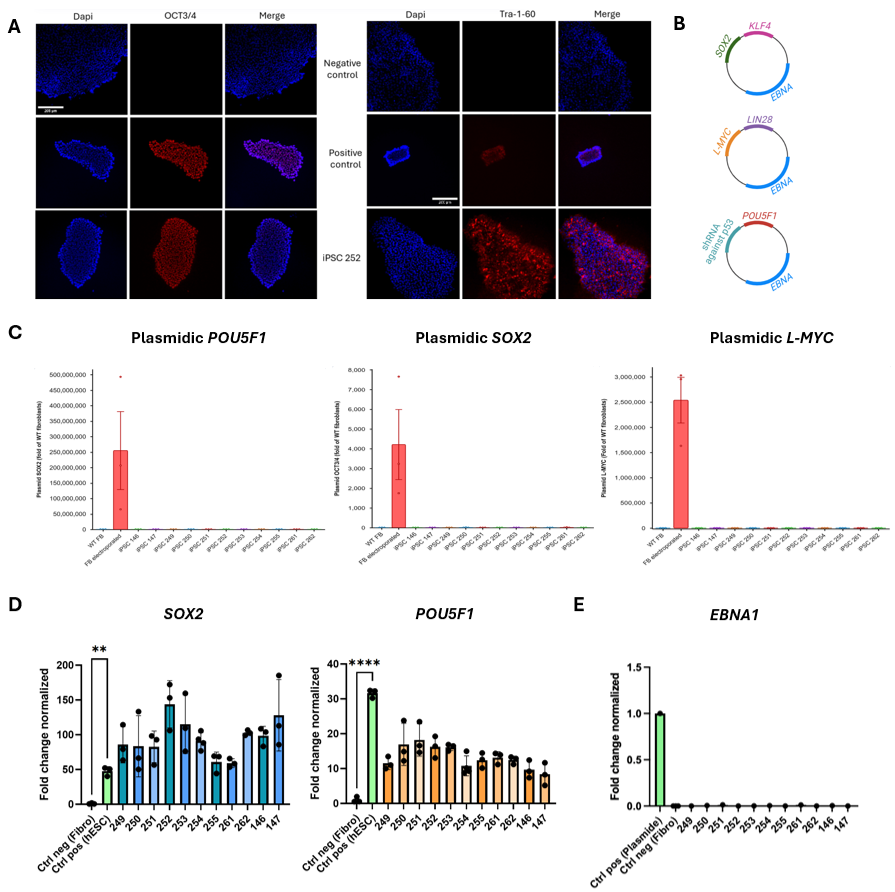
Characterization of iPSCs derived from patients and healthy controls indicates successful reprogramming. Fibroblasts from 8 patients and 3 control subjects were reprogrammed into iPSCs via electroporation. A) Immunofluorescence detecting the pluripotency protein markers OCT3/4 and TRA-1-60. The positive control consists of human embryonic stem cells, and the negative control consists of iPSCs stained without secondary antibodies. Scale bar: 200 μm. B) Schematic of the plasmids used to reprogram fibroblasts into iPSCs. The sequences analyzed during characterization are indicated. C) RT-qPCR showing expression levels of the plasmid-derived genes POU5F1, SOX2, and L-MYC (encoded by the plasmids used for reprogramming). Expression is normalized to RPLP0. None of the iPSC lines express the plasmid-derived genes. Positive control: fibroblasts harvested 48 hours after electroporation. Negative control: non-reprogrammed fibroblasts. D) RT-qPCR showing expression levels of the pluripotency marker genes SOX2 and POU5F1, normalized to RPLP0. All iPSC lines express the pluripotency markers. Positive control: human embryonic stem cells. Negative control: non-reprogrammed fibroblasts. E) qPCR showing expression levels of the consensus plasmid gene EBNA, normalized to RPLP0. Positive control: PXCLE plasmid. Negative control: non-reprogrammed fibroblasts.
Project description
CANVAS syndrome is a rare, late-onset neurological disorder characterized by cerebellar ataxia, vestibular dysfunction, and sensory neuropathy. It is caused by AAGGG repeat expansions in the second intron of the RFC1 gene. Although the genetic cause is known, the mechanism linking these expansions to the cerebellar atrophy characteristic of the disease remains unknown.
We hypothesize that RFC1 expansions lead to structural and epigenetic DNA modifications, thereby reducing gene expression and disrupting early cerebellar development. Consequently, we aim to determine the molecular mechanisms linking the expansions to RFC1 expression and to characterize the developmental defects caused by the disease. To achieve this, fibroblasts from patients and controls have been reprogrammed into induced pluripotent stem cells (iPSCs) and differentiated into cerebellar organoids, which recapitulate the architecture and cell populations of the cerebellum. This approach will allow us to assess alterations in patient fibroblasts and in a cerebellar model derived from the patients’ own cells.
As the mission of CERMO-FC is to support research into orphan diseases, this project aligns directly with its priorities, given that it aims to elucidate the pathogenic mechanisms of a rare neurological disease for which no curative treatment exists.
Research team
Name: Geneviève Larocque
Supervisor: Éric Samarut and Anthony Flamier
Recipient: CERMO-FC master’s scholarship 2026