Project description
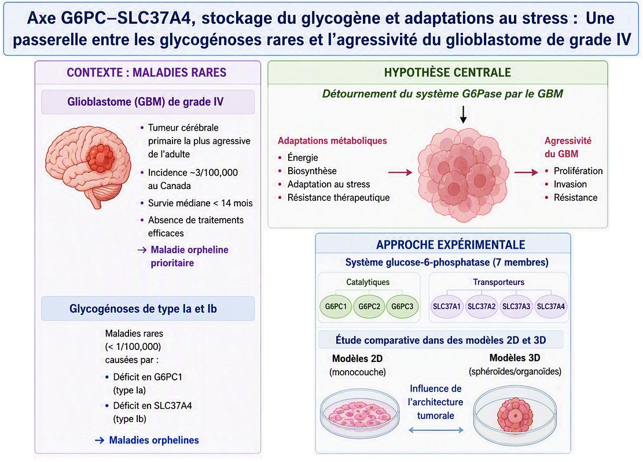
Grade IV glioblastoma (GBM) is the most aggressive primary brain tumor in adults. Despite its low incidence in Canada, its almost invariably incurable nature, median survival of less than 14 months, and the lack of effective treatments make it a priority orphan disease. This project proposes an innovative mechanistic link between GBM and glycogen storage disease types Ia and Ib, two rare disorders caused by deficiencies in G6PC1 or SLC37A4. The central hypothesis is that GBM co-opts specific components of the glucose-6-phosphatase system to support its metabolic adaptation and aggressiveness. A comparative analysis of the seven members of this system, G6PC1-3 and SLC37A1-4, in two-dimensional and three-dimensional cell models will provide a better understanding of how tumor architecture influences these mechanisms. The project will therefore address major knowledge gaps in both GBM biology and glycogen storage diseases. It directly aligns with CERMO-FC’s mission by advancing fundamental mechanistic and translational knowledge, while leveraging the Centre’s flow cytometry and confocal microscopy platforms. The findings could reveal new metabolic therapeutic targets and contribute to training the next generation of highly qualified Quebec scientists in orphan disease research.
Research team
Name: Abdallah Fallah
Supervisor: Borhane Annabi
Recipient: CERMO-FC doctoral scholarship 2026